

Nornic Labs · Research prototype
Can AI Help Us Make Better Decisions Without Making Them for Us?
This Nornic Lab prototype explores how different forms of decision support affect understanding, trust, autonomy, and the quality of consumer choices.
The goal is not to maximize compliance. The goal is to test whether AI can make complexity easier to understand while keeping the human in command.
The premise is augmentation, not automation: the mind stays in charge, and any computational layer exists to make complexity visible — never to decide on your behalf.
What participation involves
Six quiet steps, one honest decision
Study information and consent
You read what the prototype does, what is recorded, and how to withdraw — before anything is stored.
A few baseline questions
Short, minimal questions. No account, no email, no name — an anonymous study identifier only.
An assigned scenario
You receive a hypothetical mobile-service usage profile and are asked to decide on its behalf.
One decision
You choose one of six service plans. Depending on random assignment, you may see no assistance at all, or one form of decision support. Any recommendation can be rejected.
A short survey
How the decision process felt — understanding, confidence, autonomy. There are no right or wrong answers.
Debrief
The session ends by explaining exactly how any recommendation you saw was computed.
The experiment at a glance
One decision, four randomized forms of support
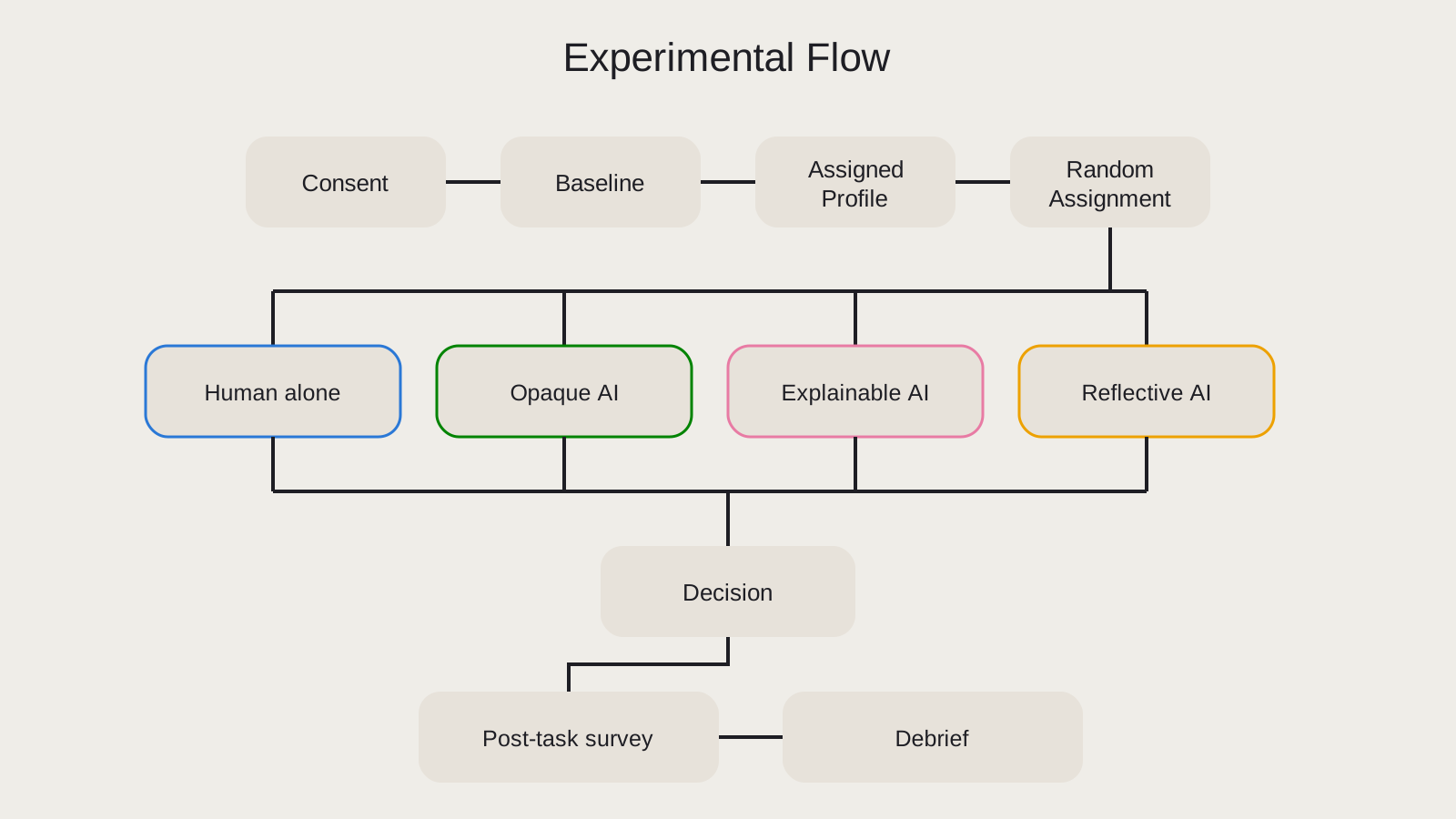
Every participant walks the same path — consent, baseline, an assigned consumer profile, one plan decision, a short survey, and a debrief. Random assignment changes only the decision support shown during the task; every screen is otherwise identical.
Ethical commitments
The rules this prototype holds itself to
- 01
You stay in command
Every recommendation is optional and clearly rejectable. Nothing is preselected, and there is no penalty for choosing differently.
- 02
No dark patterns
No urgency, no false scarcity, no hidden defaults, no social-proof nudges, no emotional exploitation — inside or outside the task.
- 03
Deterministic, auditable AI
Recommendations come from a versioned, deterministic scoring engine. No large language model decides anything, and explanations match the actual calculation.
- 04
Data minimization
Only what the protocol requires is collected, under an anonymous identifier. Data is versioned, exportable, and deletable on request.
- 05
No third-party tracking
Study routes carry no advertising pixels, no session replay, and no marketing analytics. No personal data is sent to external AI services.
- 06
Honest evidence
Synthetic engineering data is always labeled as such and never presented as a human finding. Results are reported only in aggregate.
Ten minutes. One decision. Full transparency at the end.
This prototype does not provide real purchasing advice.