
Prediction
What will the person choose?
Forecasting behavior from data. Powerful, increasingly commoditized — and silent about whether the predicted choice is good for the person making it.

About the research
Consumer AI is very good at predicting what people will do. It is far less clear whether it can help people decide well. This project separates three goals that are routinely conflated, and studies the third — influence — with an unusual objective: the decider’s own judgment and welfare, not a conversion metric.
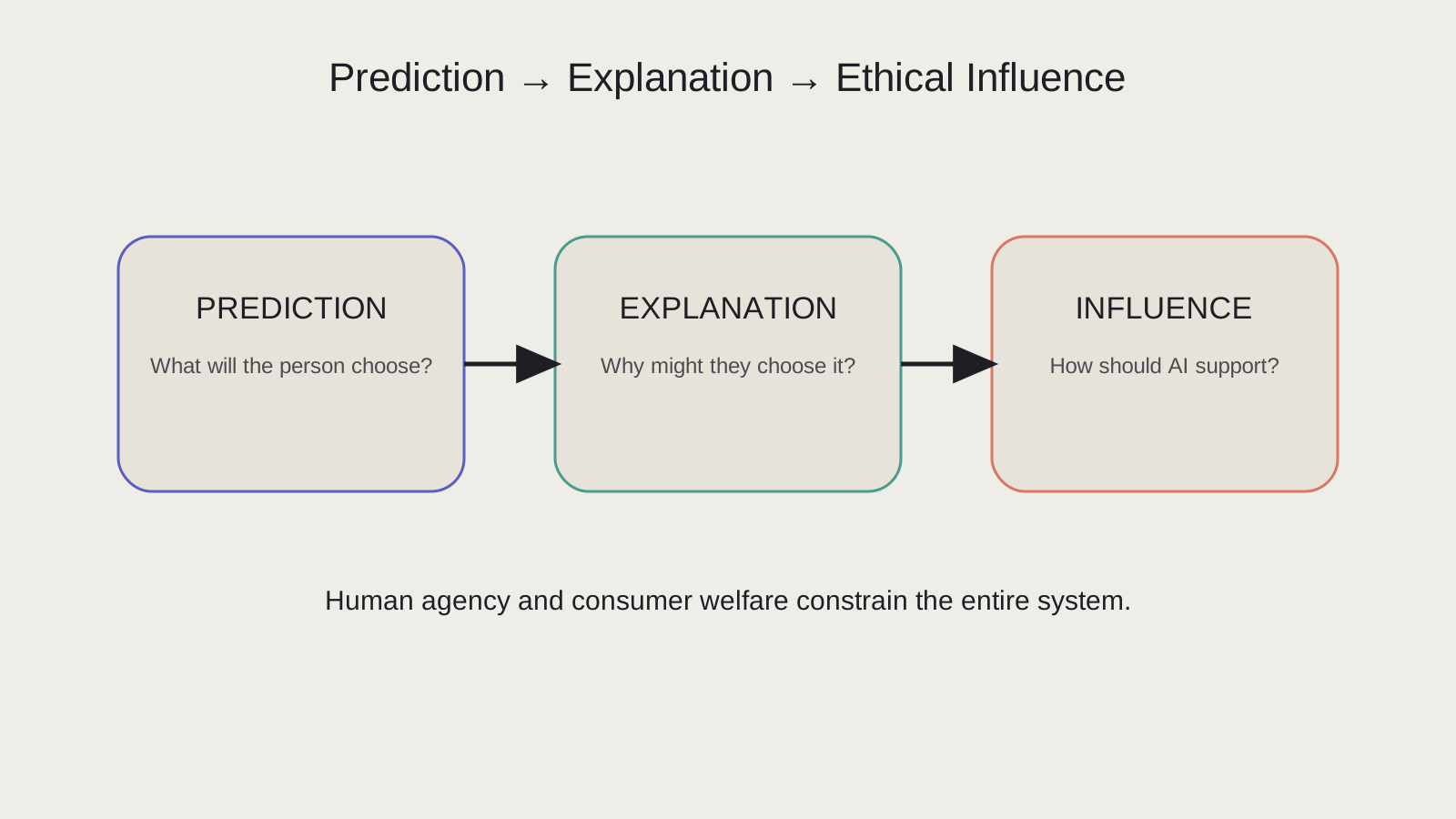
What will the person choose?
Forecasting behavior from data. Powerful, increasingly commoditized — and silent about whether the predicted choice is good for the person making it.
Why might they choose it?
Understanding the reasons behind a choice. An explanation is only useful if it is faithful — a true account of the calculation, not a plausible story told after the fact.
How should AI support the decision ethically?
Changing the decision process itself. The ethical line: support engages a person’s deliberation, while manipulation bypasses it. This project lives entirely on the support side of that line.
Human-centered AI
Conventional consumer AI optimizes the firm’s metric — clicks, conversion, retention, revenue. A human-centered system is accountable to the decider instead: objective decision quality, understanding, autonomy, satisfaction, and reduced regret. Four commitments follow from that switch.
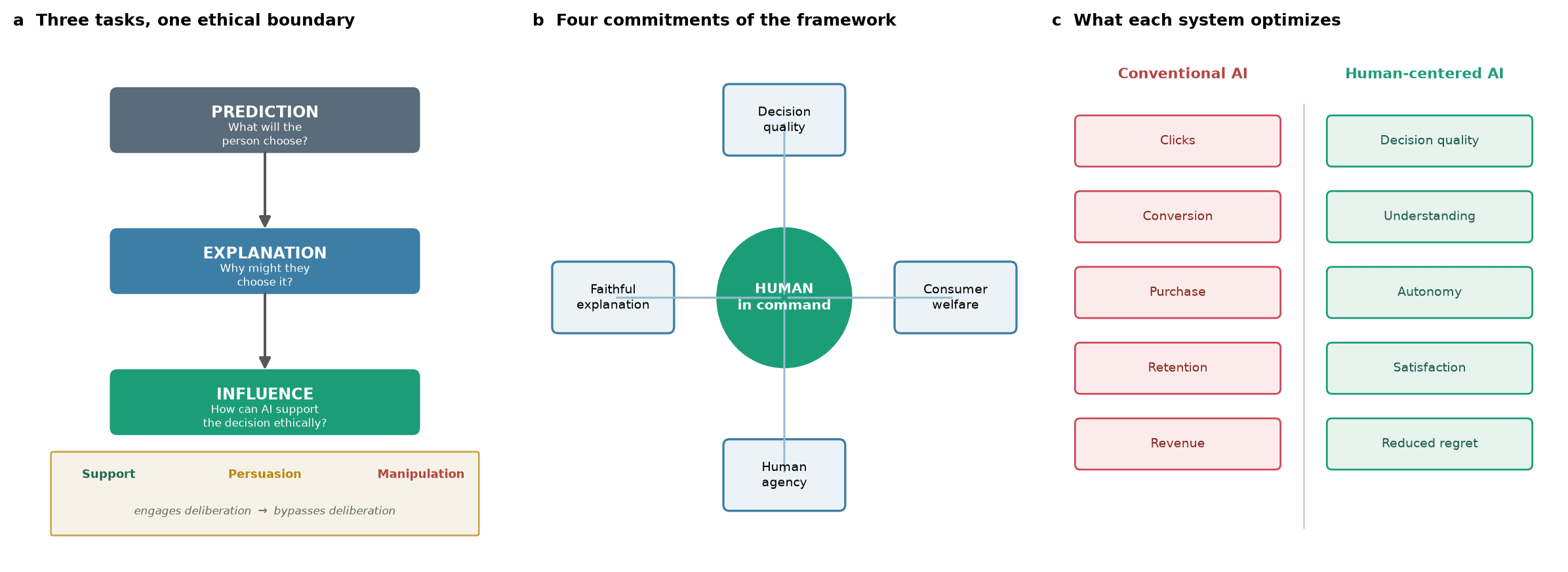
The system recommends; the person decides. Overriding the AI is always easy, visible, and free of friction or penalty.
When reasoning is shown, it is the actual computation — inspectable arithmetic over stated inputs, never a post-hoc rationalization or fabricated confidence.
Success is measured by whether the person chose well for their situation, not by whether they complied with the system.
Perceived autonomy, perceived manipulation, and override behavior are recorded as first-class outcomes alongside decision quality.
The study, at a high level
Randomized, between-subjects, four-condition online experiment. Participants receive a realistic mobile-service usage profile and choose one of six plans. The objectively best-value plan can be computed from the profile, which makes decision quality measurable rather than assumed.
The participant decides with the plan information only — no recommendation of any kind.
A recommendation is shown without any reasoning.
The same recommendation, together with the calculation behind it, open for inspection.
The system first asks what the participant considers important, then recommends a plan aligned with those stated priorities.
Where a recommendation appears, all conditions share the same deterministic computation, and every screen is visually identical except for the assigned form of support. Directional hypotheses and the analysis plan are published in the OSF preregistration — not on participant-facing pages — to avoid biasing behavior.
Primary outcome. Objective decision quality — the ratio of the cheapest eligible plan’s cost to the cost of the plan chosen; 1 means the optimal choice.
Privacy & consent
This is an engineering prototype. Public recruitment and any claims of research findings will only follow the applicable ethics review; the study design is preregistered on OSF.